
Researchers have long observed that one particular day each year behaves differently from all others. On this day, daylight appears to pause, shadows stretch unusually long, and night seems to linger far beyond normal hours. Though many people barely notice it, this phenomenon marks the longest night of the year — an important milestone in Earth’s annual journey around the Sun.
This event is known as the winter solstice, and it plays a crucial role in shaping the seasons we experience on Earth.
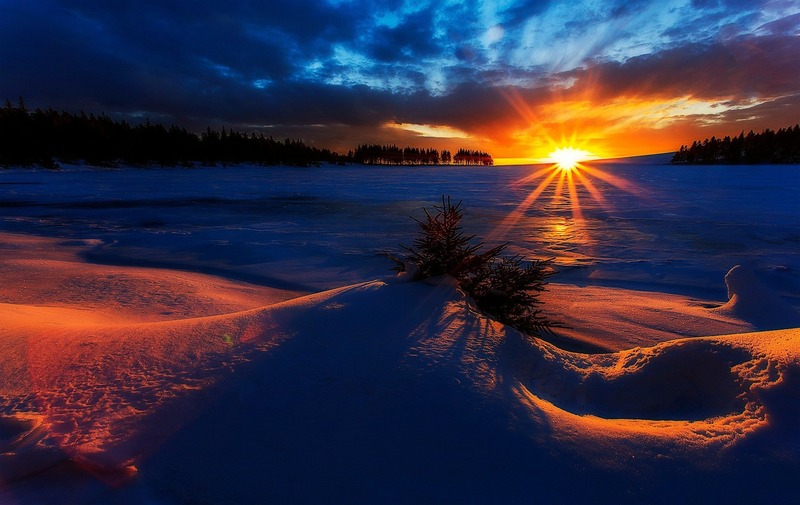
Why Do Seasons Change on Earth?
Seasonal changes are among the most predictable patterns on the planet, yet their cause is often misunderstood. Contrary to popular belief, seasons are not created by changes in Earth’s distance from the Sun. Instead, they occur because of the tilt of Earth’s axis.
Earth does not spin upright. Its axis is tilted at about 23.5 degrees, and this tilt remains fixed as the planet orbits the Sun. Because of this, different parts of the Earth receive varying amounts of sunlight at different times of the year. This variation in sunlight determines the length of days and nights, ultimately creating the four seasons — spring, summer, autumn, and winter.
What Happens During the Winter Solstice?
As Earth continues its orbit, it reaches a point where daylight hours in the Northern Hemisphere become shorter than at any other time of the year. During this moment, the Sun follows its lowest and shortest arc across the sky, resulting in minimal daylight and the longest night.
This moment is called the winter solstice, which marks the official beginning of astronomical winter in the Northern Hemisphere. At the same time, the Southern Hemisphere experiences its summer solstice, enjoying the longest day of the year.
The winter solstice occurs because the Northern Hemisphere is tilted away from the Sun, causing sunlight to strike the region at a much lower angle. As a result, sunrise comes later, sunset arrives earlier, and nighttime stretches longer than usual.
When Is the Winter Solstice in 2025?
In 2025, the winter solstice is expected to occur on Sunday, December 21. On this day, countries in the Northern Hemisphere will experience their shortest day and longest night of the year.
After the solstice passes, the Sun’s position slowly begins to shift northward again. Although the change is subtle and not immediately noticeable, daylight gradually starts increasing day by day until it reaches its peak during the summer solstice.
Why Ancient Cultures Revered the Longest Night
Long before modern astronomy, ancient civilizations closely tracked the winter solstice. For many cultures, it symbolised rebirth, renewal, and the return of light. Farmers relied on solstice observations to plan agricultural cycles, while spiritual rituals and festivals were held to mark the transition from darkness toward longer days.
The longest night was often seen as a turning point — a reminder that even after the deepest darkness, light would inevitably return.
Does the Winter Solstice Mean the Coldest Day?
While the winter solstice brings the least amount of sunlight, it does not necessarily mark the coldest day of the year. Temperatures usually continue to drop even after the solstice due to the time it takes for oceans and land to release stored heat — a phenomenon known as seasonal lag.
Instead, the solstice serves as a reset point in Earth’s solar cycle. From this moment onward, the planet slowly progresses toward spring, even though winter conditions may intensify for weeks afterward.
A Silent but Powerful Astronomical Shift
Though it may feel like just another winter day, the winter solstice represents one of the most significant astronomical events of the year. It reflects the precise balance between Earth’s tilt, orbit, and sunlight — a cosmic rhythm that governs life, climate, and time itself.
As the longest night passes, Earth quietly begins its return toward longer days, reminding us that change is always in motion, even when it feels imperceptible.