
Fresh images and videos of interstellar comet 3I/ATLAS have sparked widespread discussion on social media, leading many users to question whether the comet is spinning as it moves through the solar system. The renewed attention follows visuals shared by Ray’s Astrophotography, updates from NASA, observations from the European Space Agency (ESA), tracking reports from the JUICE mission, and numerous posts across online communities.
Claims circulating online suggest the appearance of rotational movement, dust rings, detached shells, and changes in the comet’s coma, but none of these observations have been scientifically verified. Still, the viral content has boosted public interest in the rare interstellar visitor, which is passing through our solar system for the first and only time.
Astronomers expect upcoming high-resolution NASA imagery to provide clearer insights into these early observations.
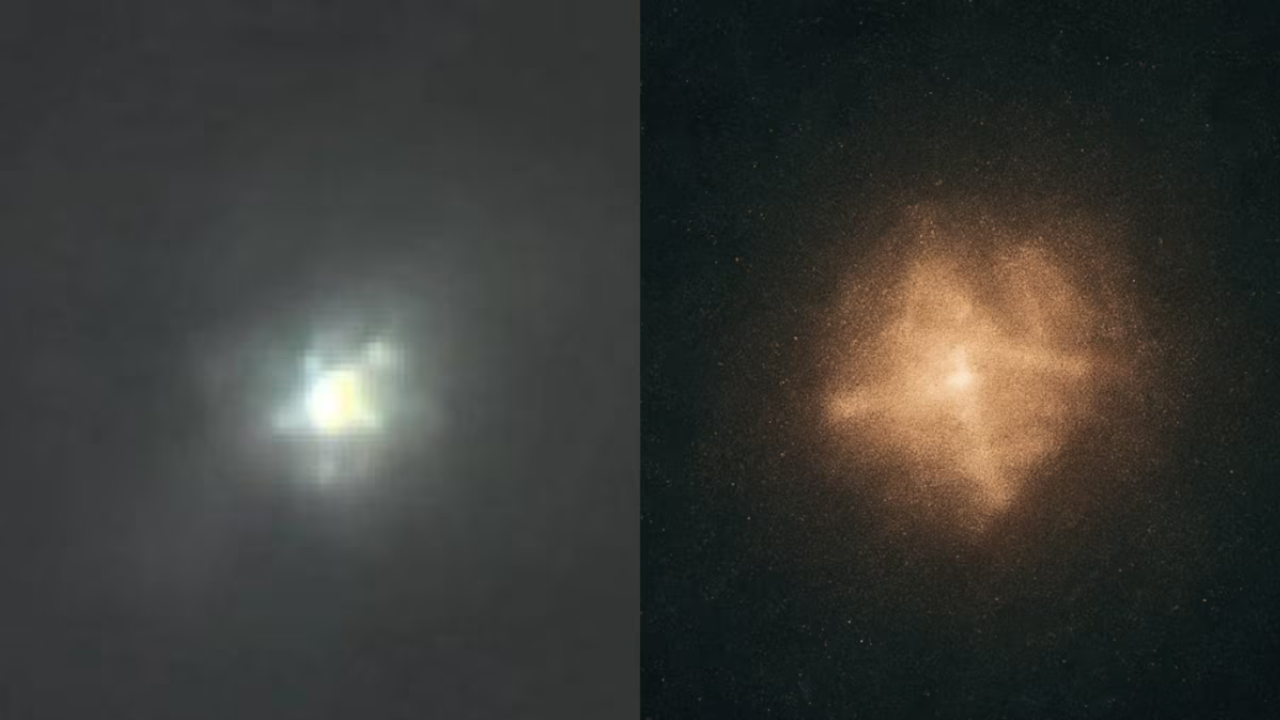
Is 3I/ATLAS Spinning? What Triggered the Question
The speculation began after several posts shared video clips and enhanced images that appeared to show swirling or spinning patterns around 3I/ATLAS. One viral post compared the visuals to an old ESA ExoMars Orbiter capture, suggesting the comet might not be a typical comet at all.
The image mentioned in the post was credited to Diego San Araujo, but the claims remain unconfirmed by any space agency.
While some viewers interpret the footage as rotational activity, astronomers caution against drawing conclusions from unverified and possibly processed images. Yet, these discussions have continued to fuel curiosity among space enthusiasts worldwide.
What Scientists Know About 3I/ATLAS
Comet 3I/ATLAS was first detected on July 1, 2025, by the NASA-funded ATLAS survey telescope located in Rio Hurtado, Chile. NASA later confirmed that it originated outside the solar system, making it only the third known interstellar object to enter our cosmic neighbourhood.
The first two were:
- 1I/ʻOumuamua in 2017
- 2I/Borisov in 2019
Astronomers classify 3I/ATLAS as an interstellar object because it follows a hyperbolic trajectory, meaning it does not orbit the Sun and will leave the solar system permanently after this flyby.
Path, Speed, and Safety: What NASA Confirms
NASA has assured that 3I/ATLAS poses no danger to Earth. The comet will pass at a safe distance while travelling at an extraordinary speed exceeding 210,000 km/h. Its rapid pace also prevents the Sun’s gravity from capturing it, ensuring that this will be its only visit to our solar system.
As the comet continues its journey, astronomers are closely monitoring new data in hopes of confirming whether the unusual visual patterns seen in early footage are real or simply artefacts of image processing.