
The India Meteorological Department (IMD) announced on Tuesday that the ash cloud from Ethiopia’s Hayli Gubbi volcanic eruption is expected to move out of the Indian region by Tuesday evening. The plume, which travelled across Yemen, Oman, and the Arabian Sea, entered Gujarat and Rajasthan on Monday evening before drifting towards Delhi around midnight. Through Tuesday, the ash mass continued its journey across eastern and northeastern parts of the country.
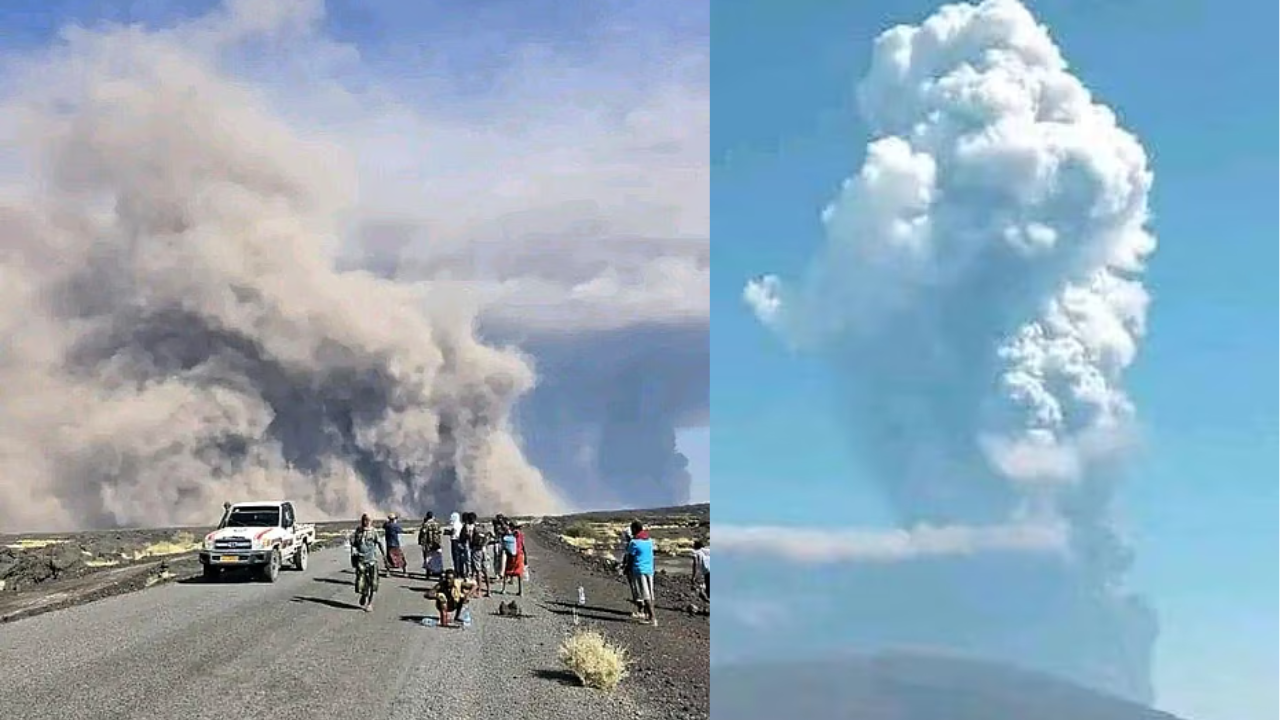
IMD Director General M. Mohapatra explained that the ash particles are circulating at altitudes between 8 km and 15 km, posing no threat at ground level. “The main impact is on aviation operations over Delhi, Kolkata and Mumbai. There is no weather or health impact as the ash remains at high altitudes and moves rapidly due to strong winds,” he said. Winds in that layer reach 100–150 km/h, preventing the ash from settling. He added that the cloud is now steadily drifting towards China via eastern India.
No Western Disturbance, But Heavy Rain Forecast for South India
While northern India is not expected to experience any western disturbance in the coming days, the IMD has issued heavy rainfall warnings for several southern states. A well-marked low-pressure system over Malaysia and the Strait of Malacca has intensified into a depression. Another low-pressure area persists over the southwest Bay of Bengal, southern Sri Lanka, and the equatorial Indian Ocean.
According to weather forecasts:
- Tamil Nadu will see heavy rainfall till November 30.
- Kerala and Mahe may receive rain on November 26.
- Coastal Andhra Pradesh, Yanam and Rayalaseema may witness rain between November 29 and December 1.
- Andaman & Nicobar Islands are likely to receive rain till November 29.
Mohapatra added that widespread rainfall can be expected across peninsular India in the coming days.
North India Records Low Temperatures
Minimum temperatures have dipped sharply across the northern region:
- Below 6°C in parts of Jammu & Kashmir, Ladakh, Gilgit-Baltistan, Himachal Pradesh, Uttarakhand and Punjab.
- 7–10°C in Haryana, Chandigarh, Delhi, West UP, and north Rajasthan.
- Hissar, Haryana, recorded the lowest at 6.3°C.
Ash Cloud Reaches India After Millennia-Old Eruption
The Hayli Gubbi volcano in northern Ethiopia erupted after nearly 12,000 years of dormancy. The ash cloud reached Gujarat on Monday night, later drifting over Delhi, Rajasthan, Punjab, and Haryana. Despite concerns, IMD clarified that the ash poses no risk to Delhi’s air quality, which remains in the “very poor” category primarily due to local pollutants.
“People need not panic. The volcanic ash is too high to affect air quality or cause health issues. Advisory has been issued only for aircraft operations,” Mohapatra stated.
Flight Disruptions Across India
The ash cloud has disrupted several international flight routes, particularly those landing in Delhi. Because volcanic ash contains sulphur and fine particles that can damage aircraft engines, airlines were instructed to avoid affected flight paths.
According to official data:
- 19 international flights were affected — 7 cancelled and 12 delayed.
- Affected routes included flights from Newark–Delhi, New York–Delhi, Doha–Delhi, Dubai–Chennai, Dubai–Hyderabad, Hyderabad–Delhi, Doha–Mumbai, and several others.
The Directorate General of Civil Aviation (DGCA) issued advisories to:
- Avoid ash-contaminated airspace
- Adjust flight routes and fuel planning
- Report any ash encounters or engine anomalies immediately
Major airlines including Air India, IndiGo, and SpiceJet faced operational disruption.
Air India apologised for the inconvenience, saying safety remains its highest priority. IndiGo assured passengers it is closely tracking the situation with global aviation agencies and has implemented all precautionary measures.