
Scientists may have captured the first direct signs of dark matter, thanks to new observations from NASA’s Fermi gamma-ray space telescope. The breakthrough discovery, reported by The Guardian, could redefine modern physics if confirmed.
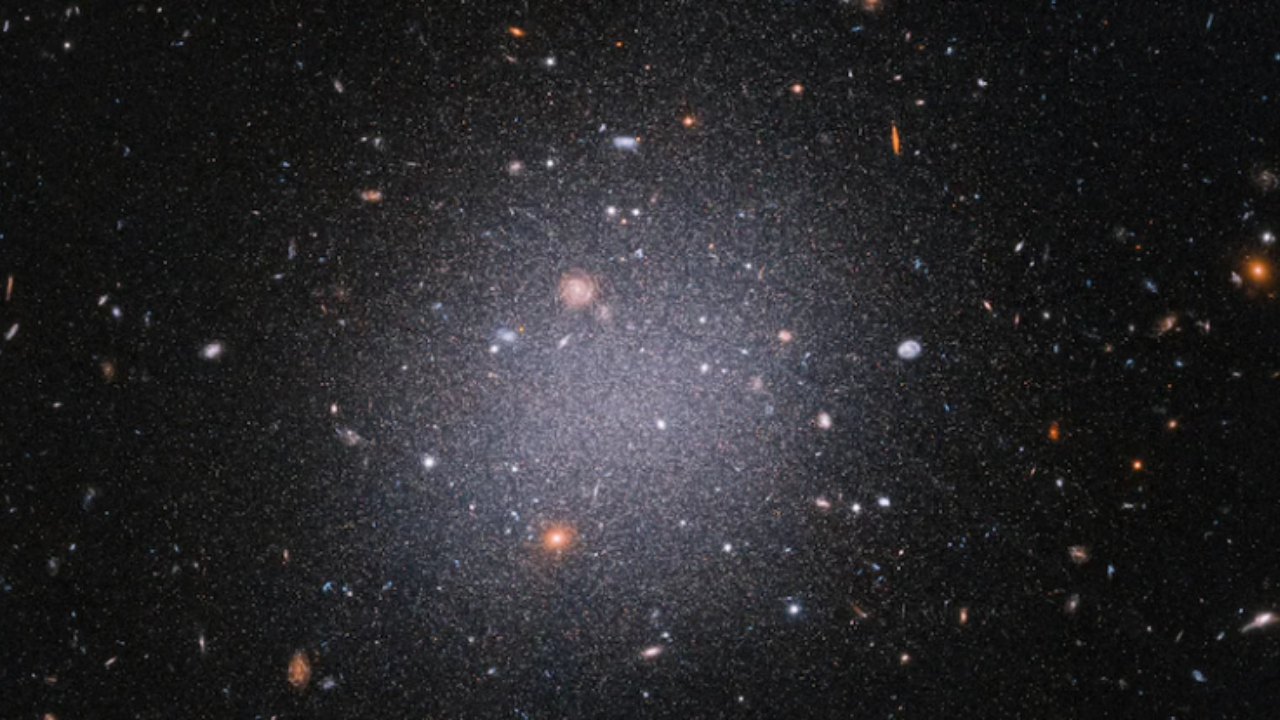
Dark matter has puzzled astronomers for nearly 100 years. The mystery began in the 1930s when Swiss astronomer Fritz Zwicky noticed that galaxies inside the Coma Cluster were moving too fast to be held together by the gravity of visible matter alone. Later, Vera Rubin’s groundbreaking research on spiral galaxies revealed that their outer edges rotated as rapidly as their centers — a phenomenon that strongly suggested the presence of an unseen mass acting as an invisible gravitational force.
Despite decades of research, dark matter has never been directly detected. It does not emit, reflect, or absorb light, making it essentially invisible. Yet scientists estimate that it makes up nearly 85% of all matter in the universe, outweighing all visible stars, planets, and cosmic structures.
A new study led by Prof. Tomonori Totani from the University of Tokyo now suggests that researchers may have identified its elusive signature. By analyzing high-energy gamma-ray data from the center of the Milky Way — a region believed to be dense with dark matter — the team discovered a halo-like glow at about 20 gigaelectronvolts. This strong and unusual signal matches predictions for WIMPs (Weakly Interacting Massive Particles), one of the leading dark matter candidates.
According to Totani, the gamma-ray pattern “closely resembles the shape expected from a dark matter halo,” and no known astrophysical sources provide a straightforward alternative explanation. If correct, the collision and annihilation of WIMPs may have produced these energetic gamma rays, offering humanity its first indirect view of dark matter.
Should further analysis support the findings, it could mark the discovery of a new particle beyond the Standard Model — a moment as historic as the detection of the Higgs boson. However, researchers remain cautious. Like any major scientific breakthrough, the claim requires extensive verification and additional data.
For now, dark matter remains one of the universe’s greatest mysteries — perhaps a little less invisible than before.