
Interstellar Comet 3I/ATLAS, a cosmic visitor from beyond our solar system, is about to reach its closest point to the Sun — an event that could change the mysterious object in multiple ways. Astronomers and space enthusiasts worldwide are eagerly watching this Manhattan-sized interstellar traveler, which has already started displaying unusual features, including a newly formed tail.
The comet, officially confirmed by NASA in July, is only the third known interstellar object ever detected in our solar system. Scientists believe it originated from a distant, unknown star system and is the largest, fastest-moving, and possibly the oldest such object ever observed.
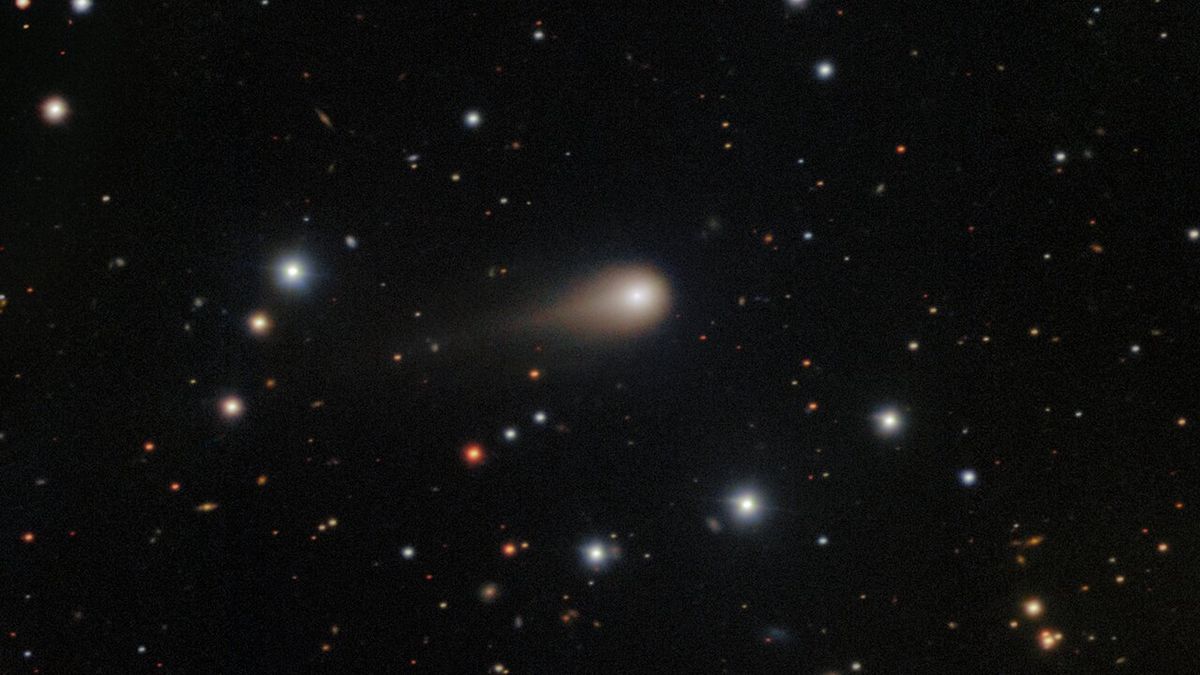
Perihelion Event on October 29
On October 29, comet 3I/ATLAS will reach its perihelion — its closest point to the Sun — before it begins its journey back into interstellar space. This critical encounter will expose the comet to intense solar radiation, potentially altering its composition, speed, and trajectory.
Typically, comets begin to outgas when nearing the Sun, as the heat turns their icy surfaces into vapor, forming a bright coma and a long tail pointing away from the Sun. However, 3I/ATLAS is breaking all the rules.
Unusual and Unexplained Behavior
Unlike traditional comets, 3I/ATLAS has displayed a tail pointing toward the Sun, a phenomenon never seen before. As per observations from the Nordic Optical Telescope in Spain’s Canary Islands, this tail even reversed direction in September — baffling astronomers.
Adding to the mystery, spectral data from telescopes revealed traces of nickel tetracarbonyl, a compound produced in industrial metal refining on Earth, but never before found in natural comets. Scientists suggest this could either indicate an unknown chemical process or — as some speculate — artificial origin.
Avi Loeb’s Controversial Theory
Harvard astrophysicist Avi Loeb, known for his theories about alien technologies, believes 3I/ATLAS might not be a natural comet at all. He suggests the object could be a maneuvering alien probe using the Sun’s gravity to slow down and possibly establish a stable orbit between Mars and Jupiter.
Loeb said, “If the anti-tail is acting as braking thrust, then the reversal near perihelion could represent a technosignature — evidence of controlled movement, not random cometary activity.”
Loeb even warned people to “take vacations before October 29,” hinting that NASA might be withholding crucial details about the object’s true nature. NASA, however, maintains that 3I/ATLAS is a comet undergoing natural physical changes.
Is It a Threat to Earth?
Despite the growing speculation, NASA assures that 3I/ATLAS poses no danger to Earth. The comet will not come any closer than 270 million kilometers, remaining safely distant from our planet.
NASA’s Hubble, Webb, and Parker Solar Probe are continuously monitoring the interstellar object to determine its composition, trajectory, and ultimate fate.
Why October 29 Matters
The date marks a key milestone in understanding whether 3I/ATLAS is merely a cosmic iceball or something engineered. Its perihelion distance — about 1.36 astronomical units (nearly the same as Mars’s orbit) — and the immense solar radiation of 33 gigawatts it will face could drastically alter its structure or trajectory, revealing once and for all what this mysterious visitor truly is.